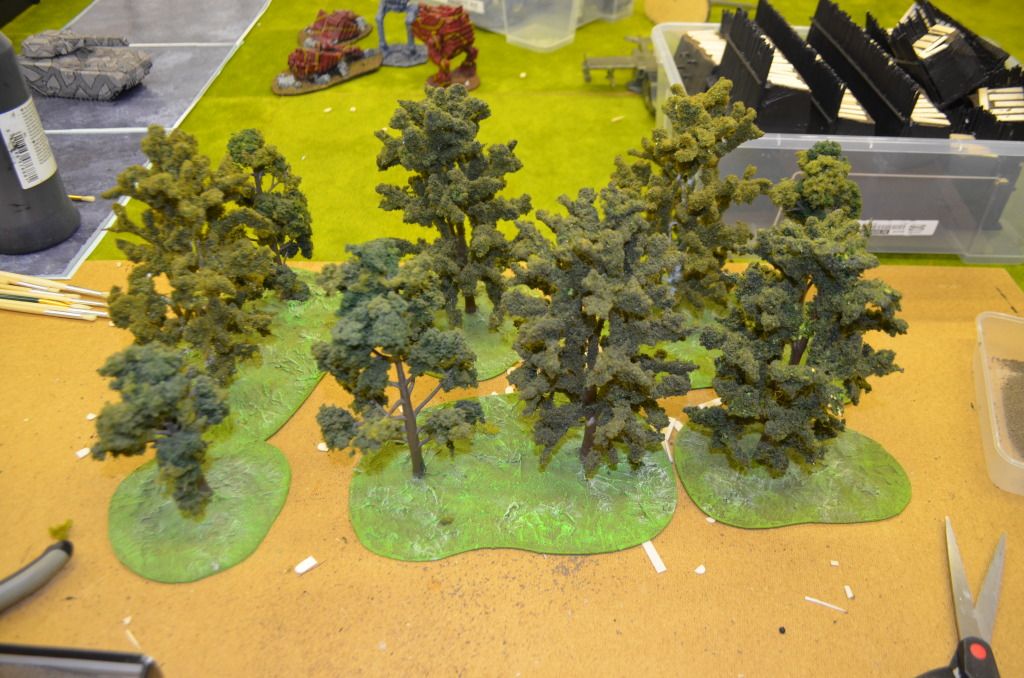
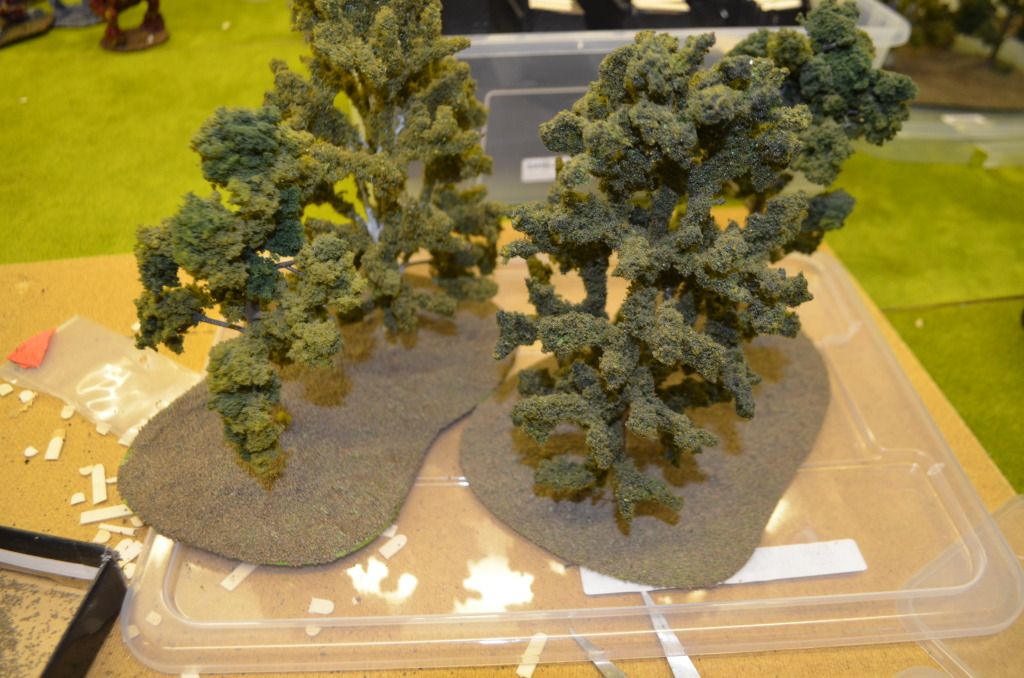
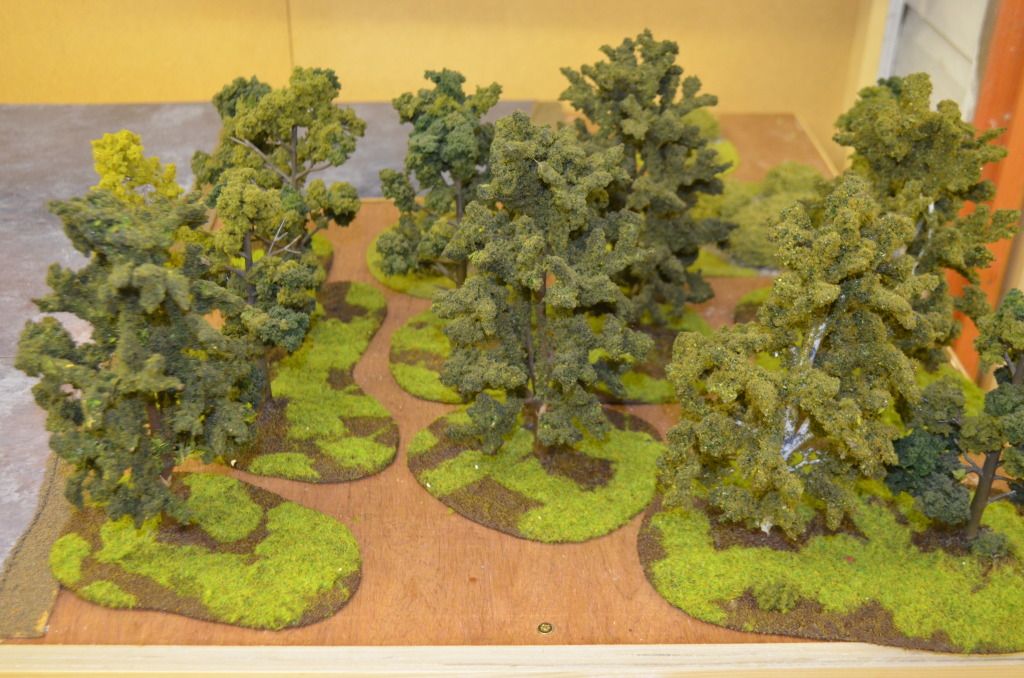
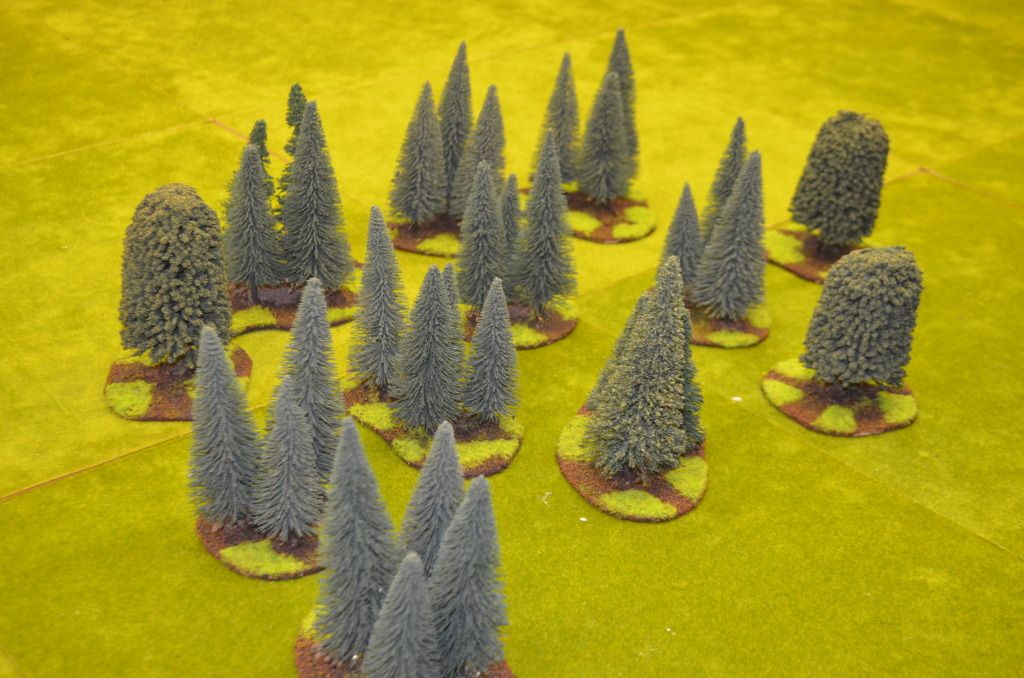
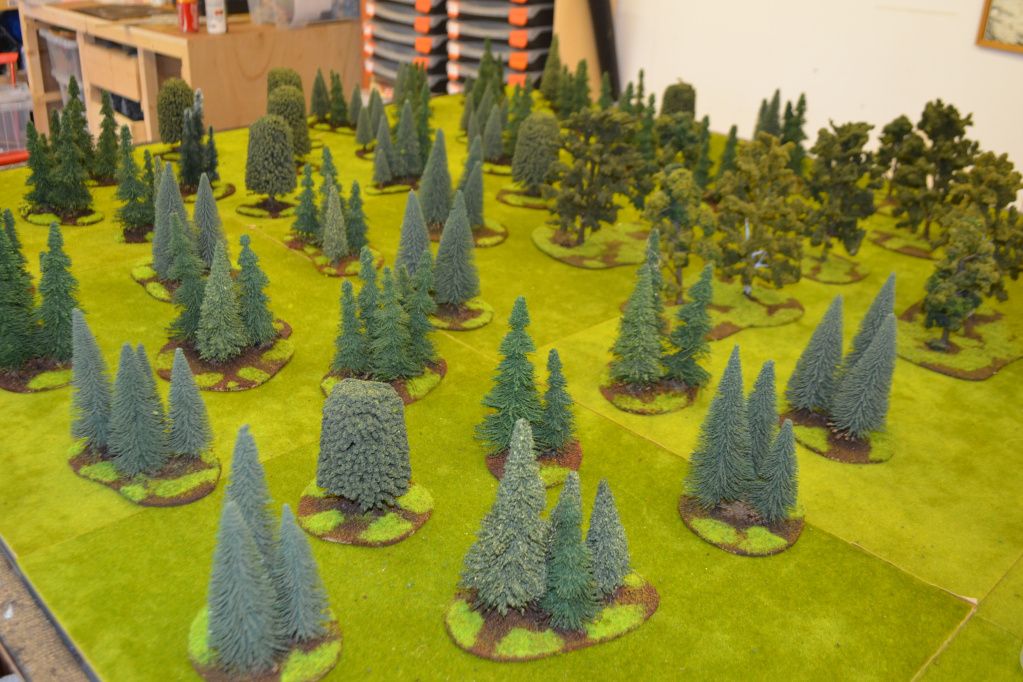
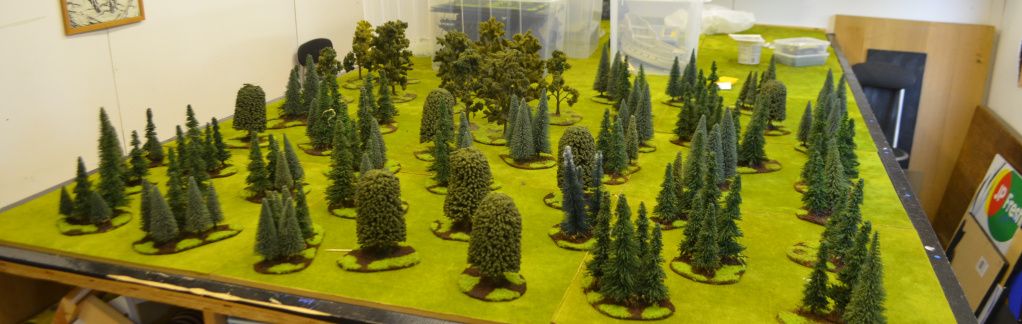
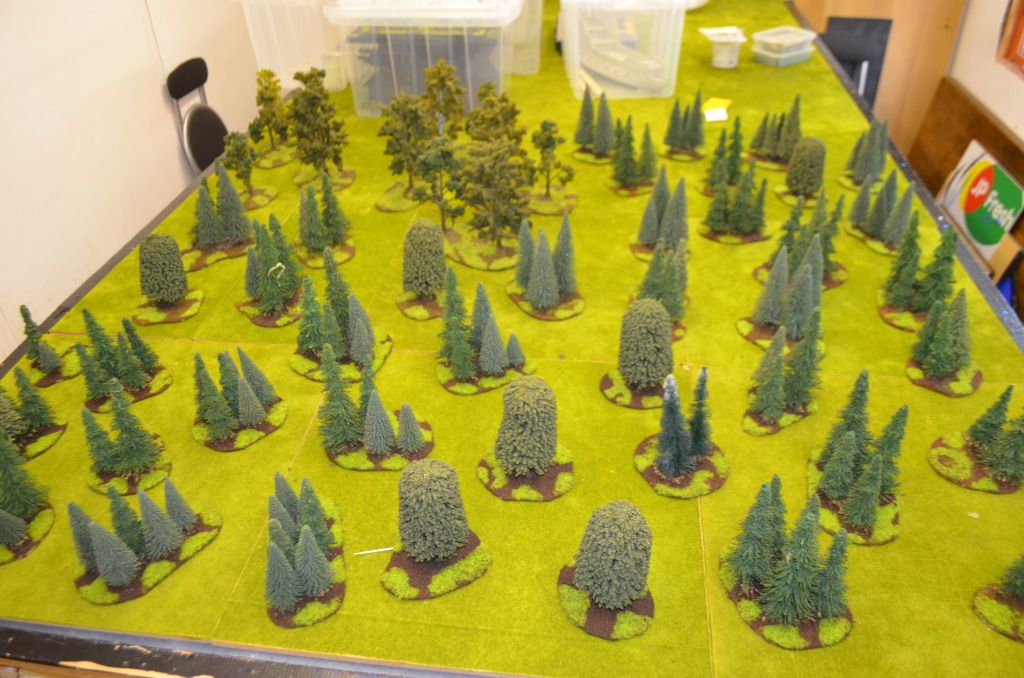
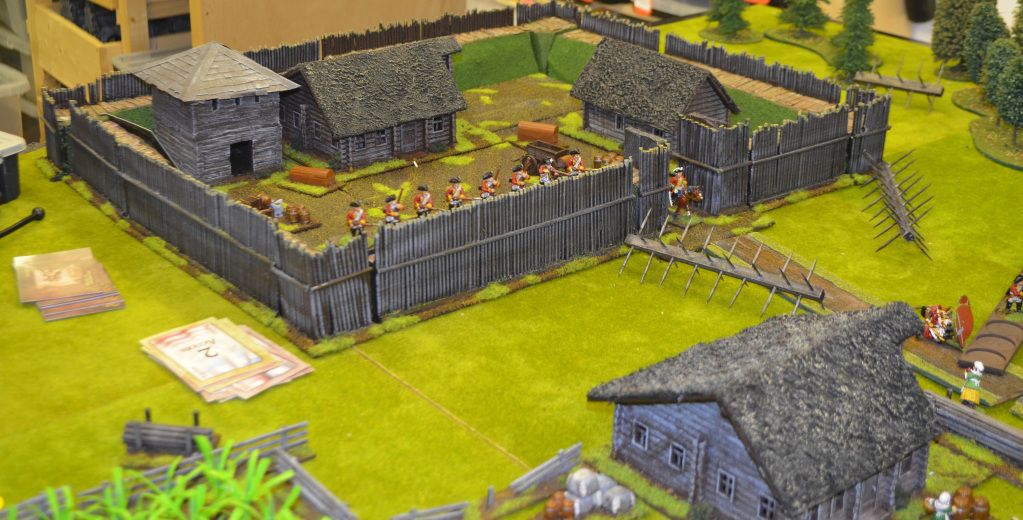
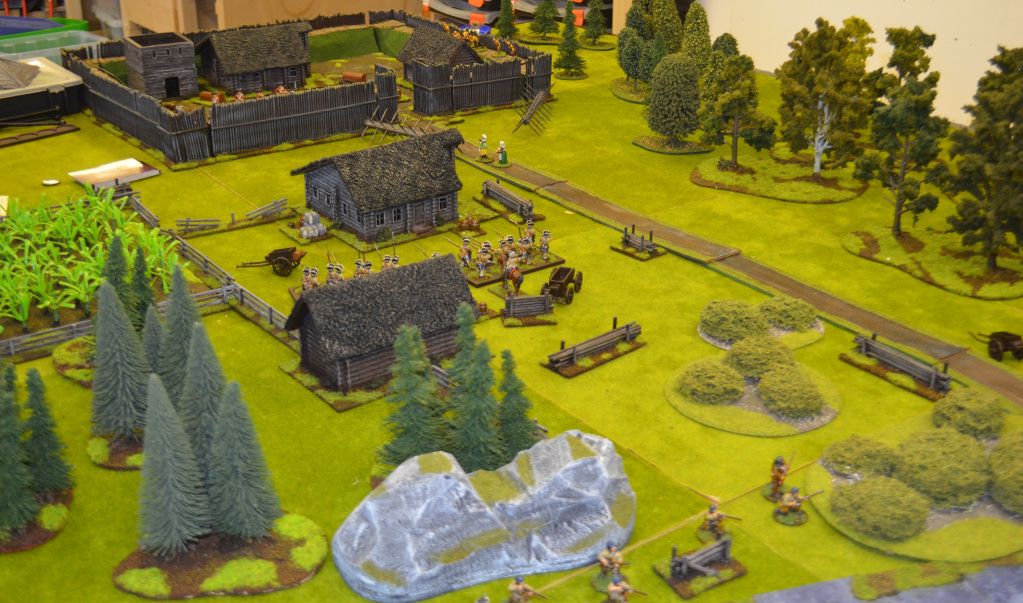
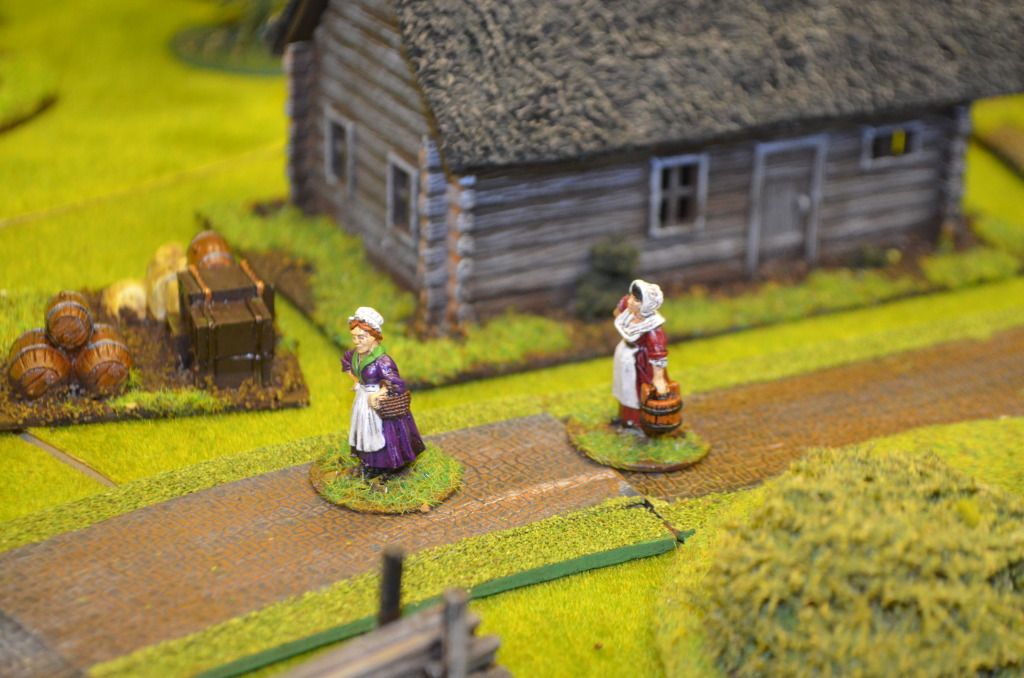
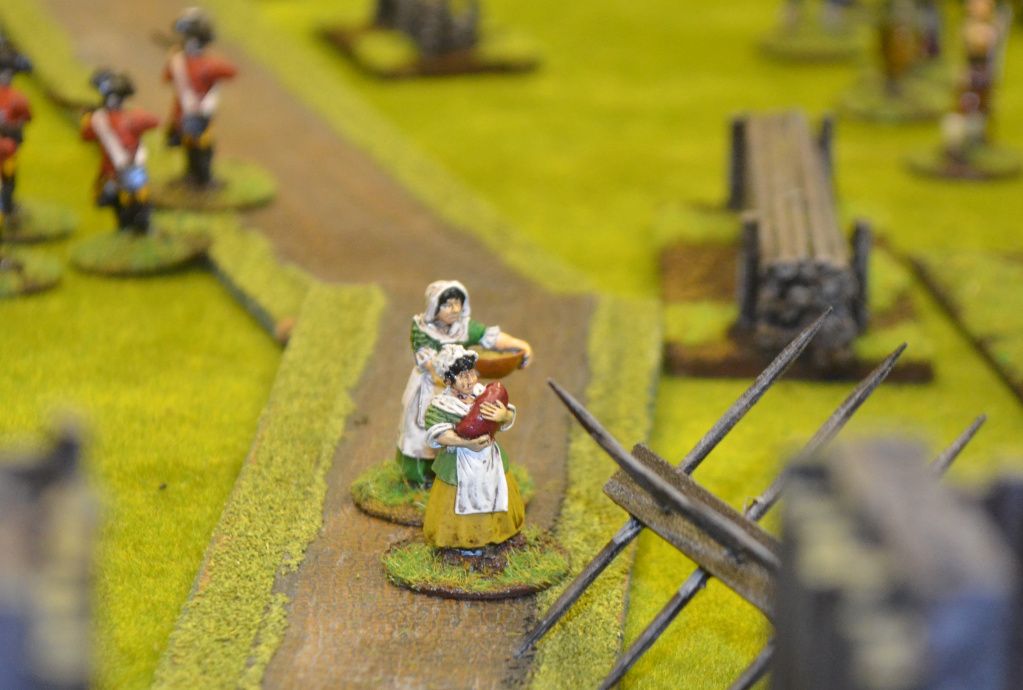
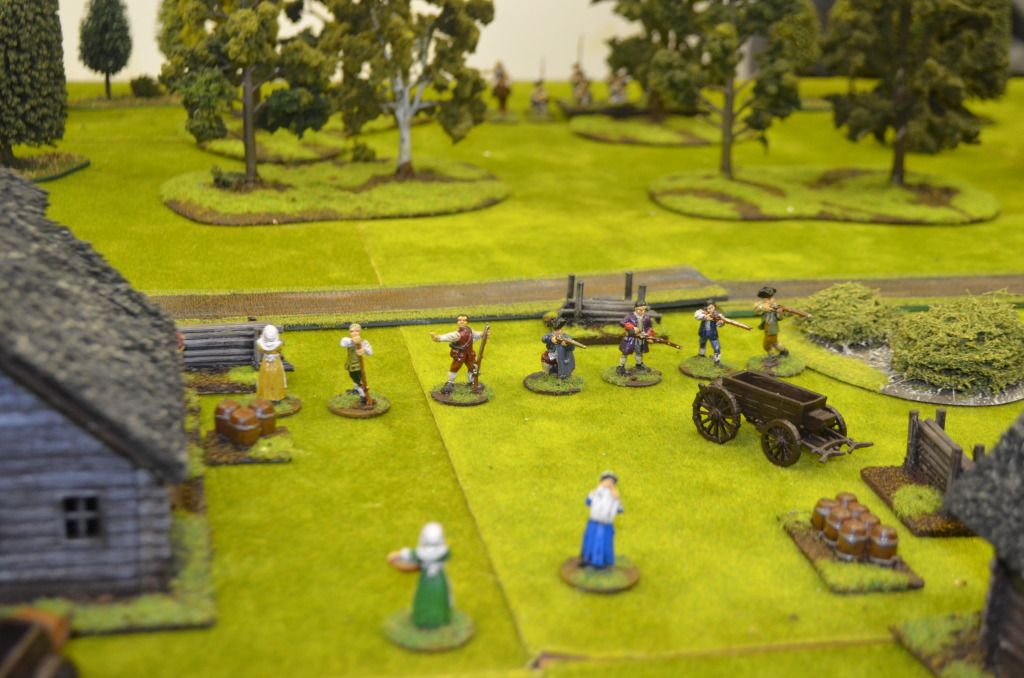
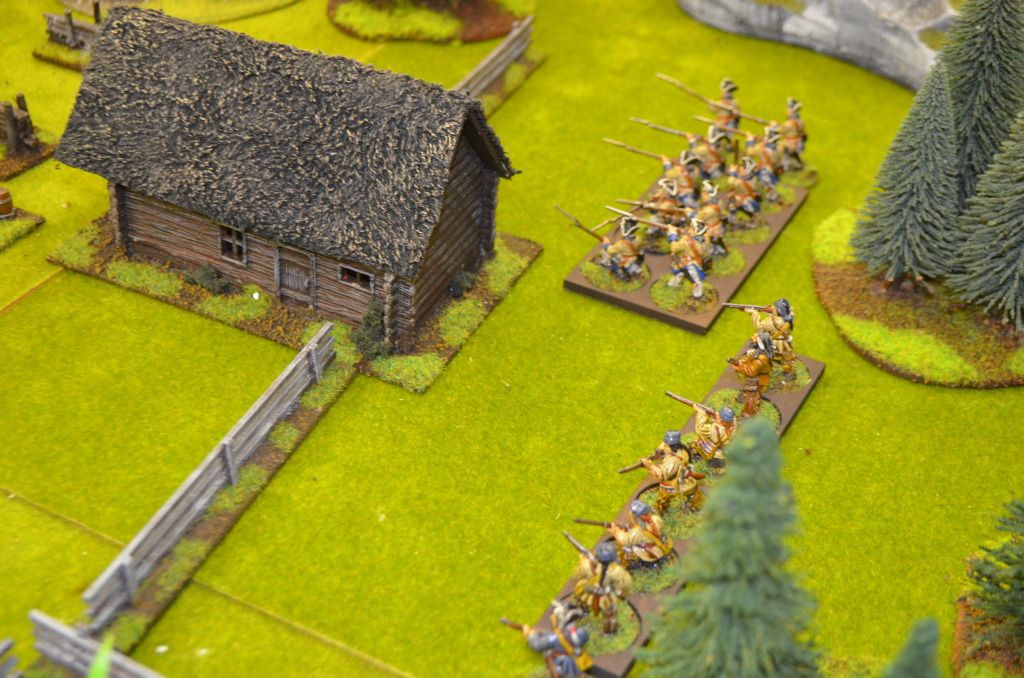
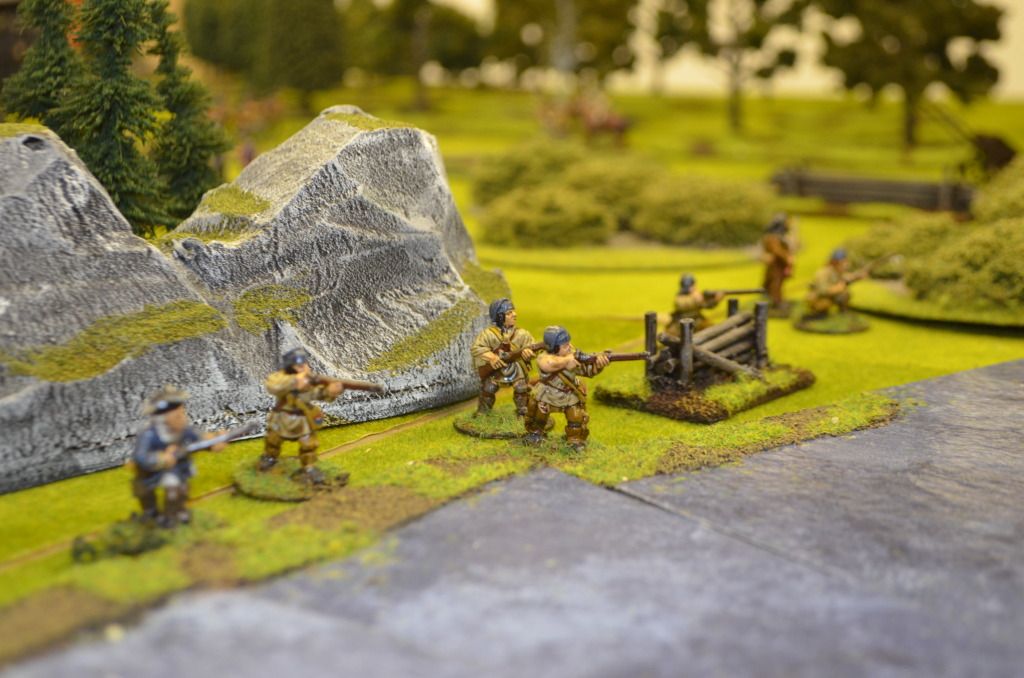
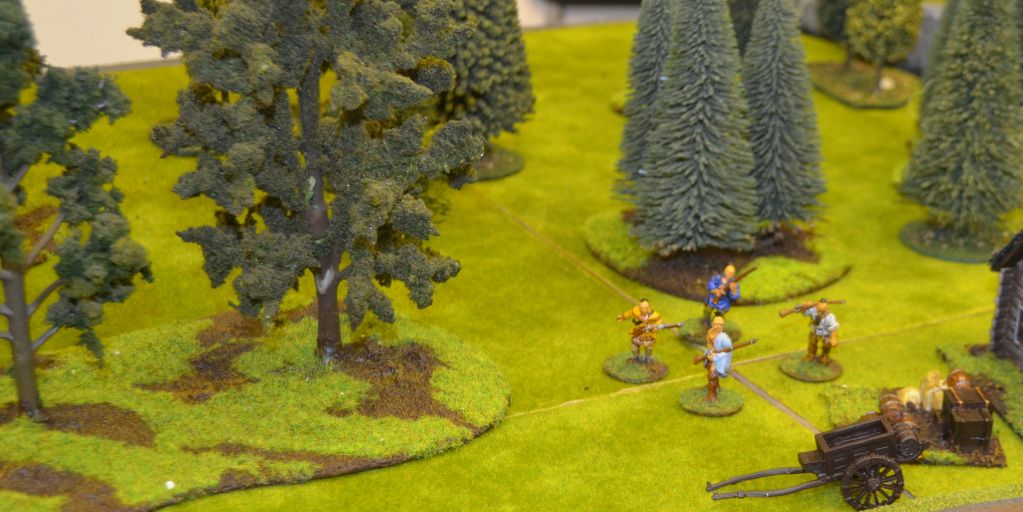
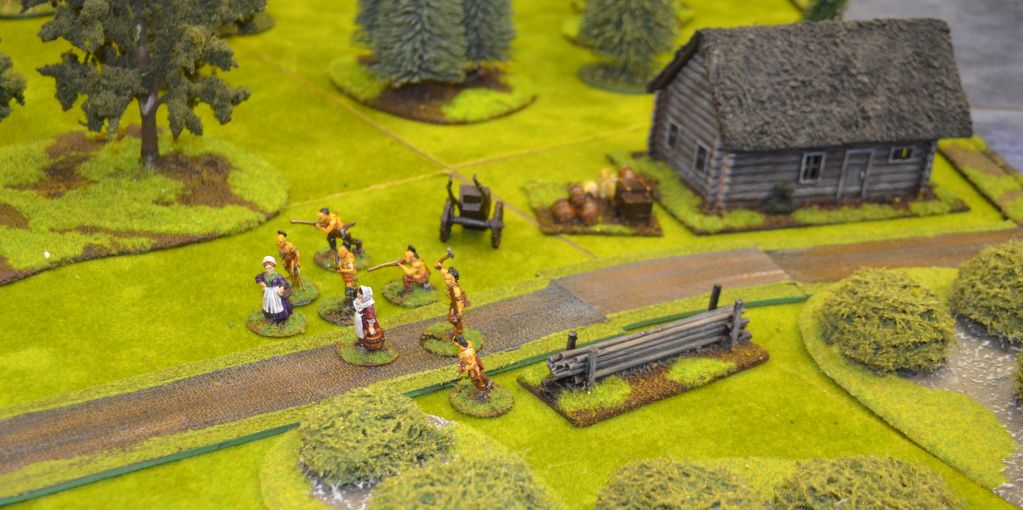
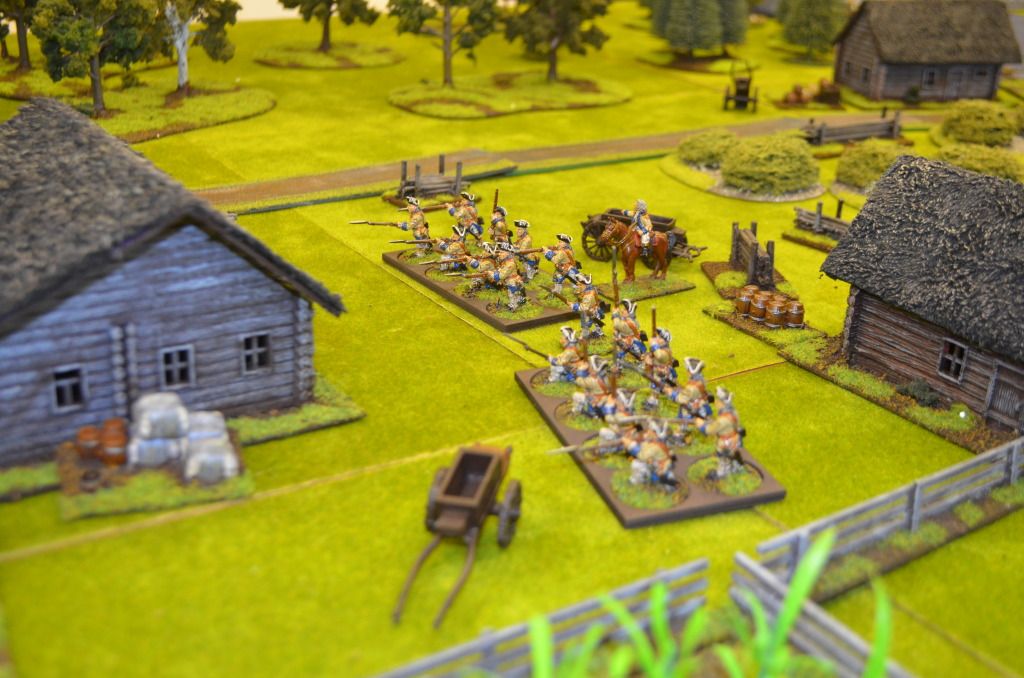
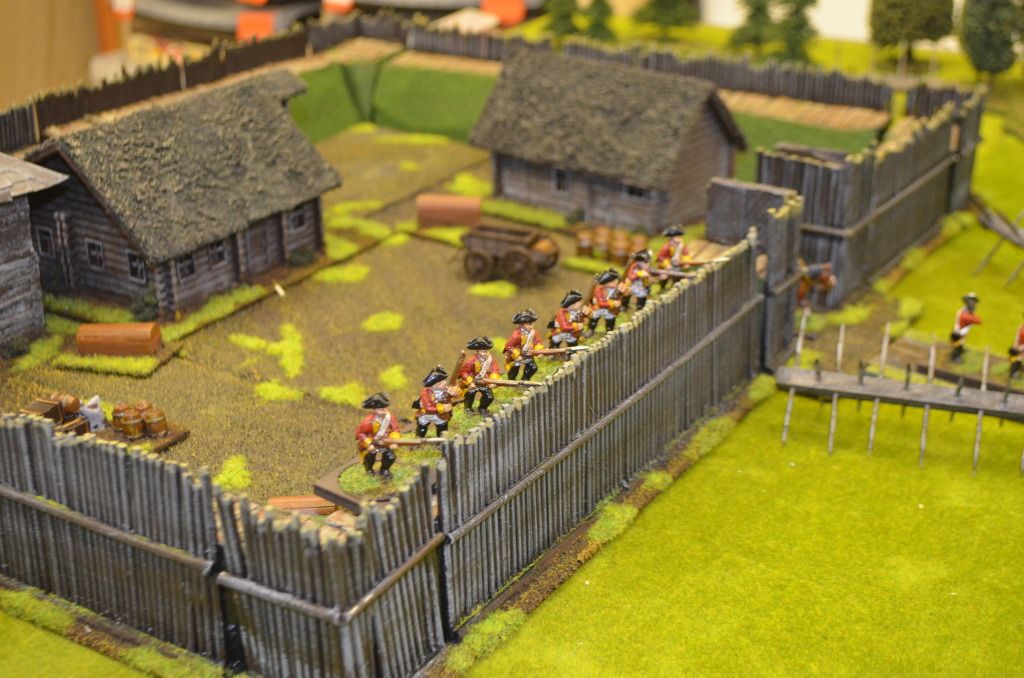
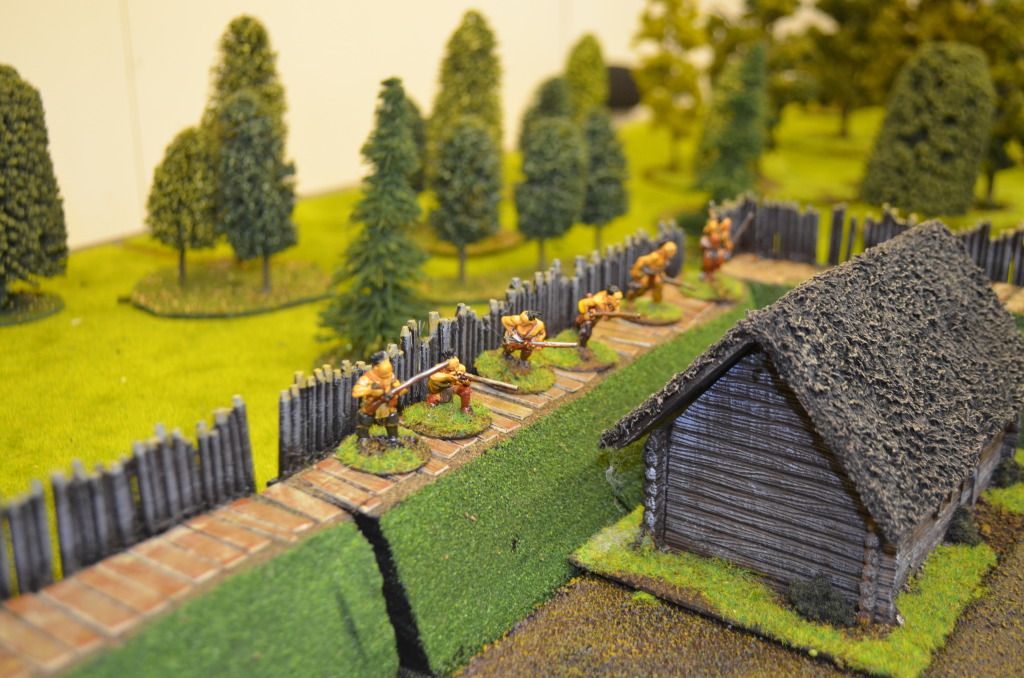
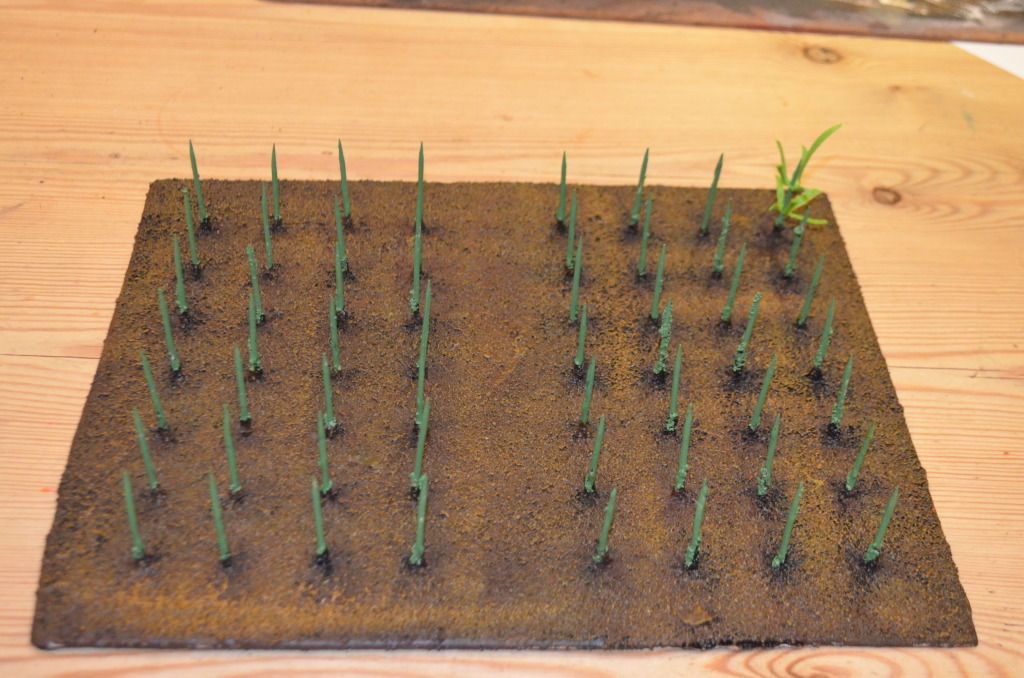
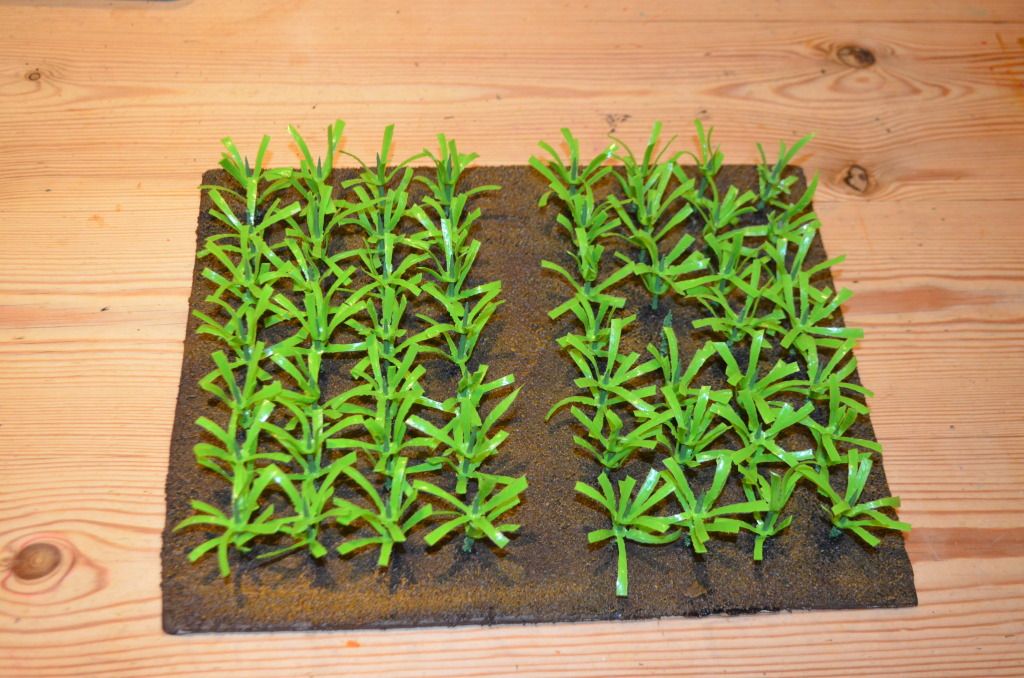
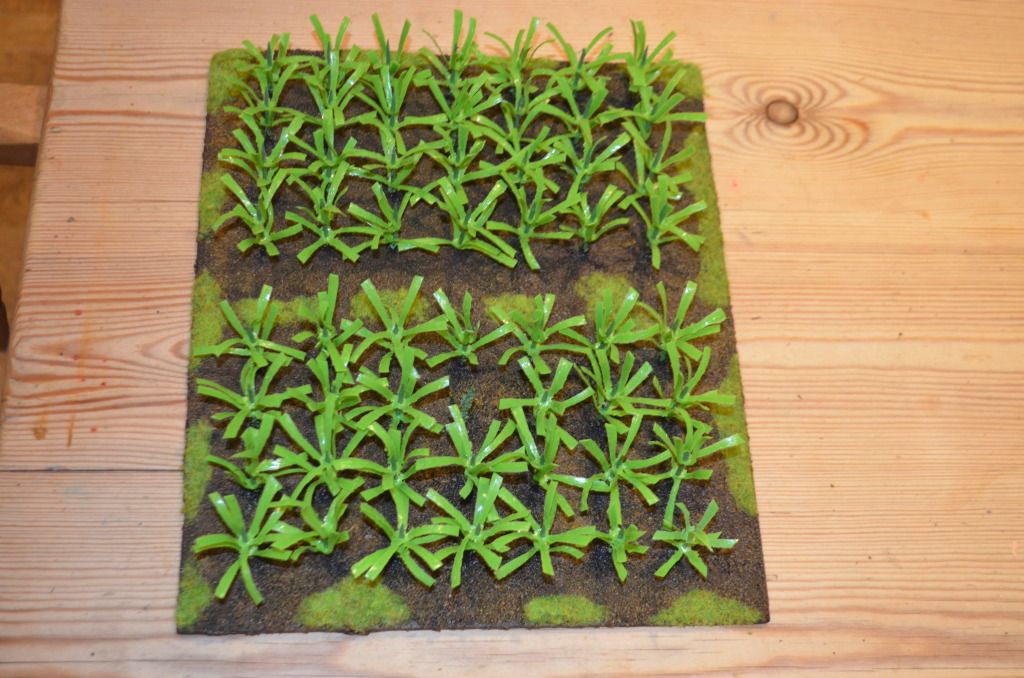
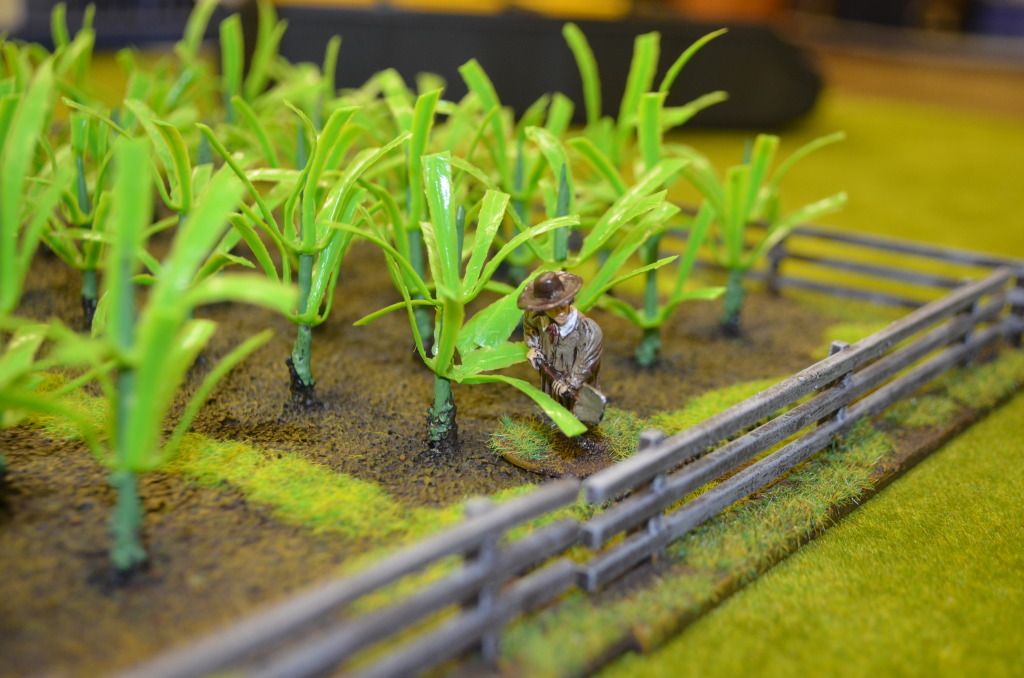
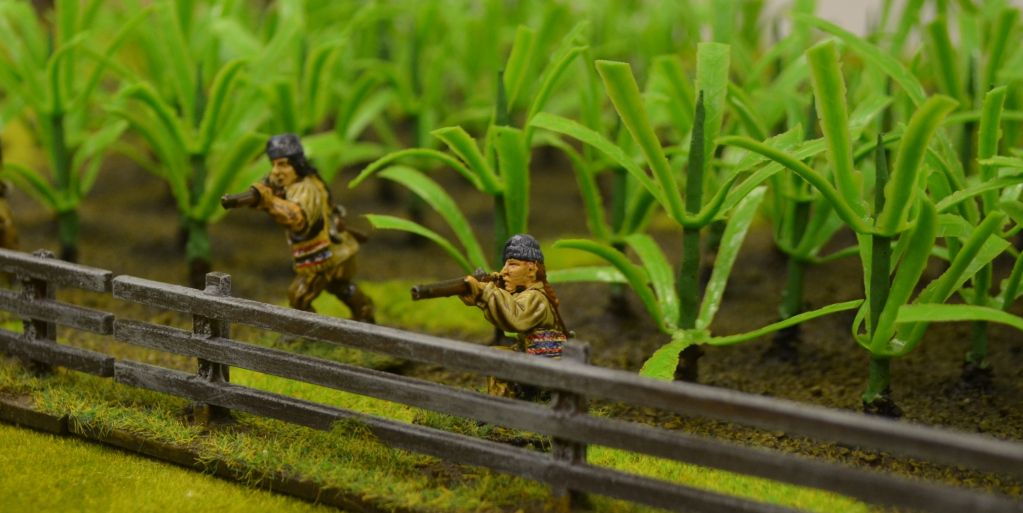
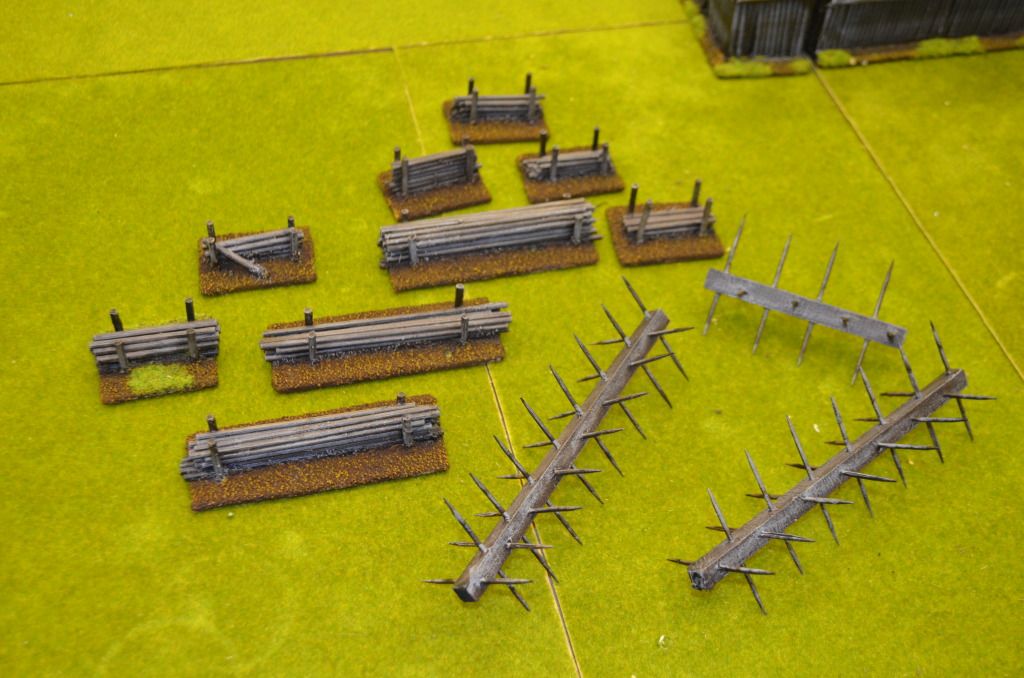
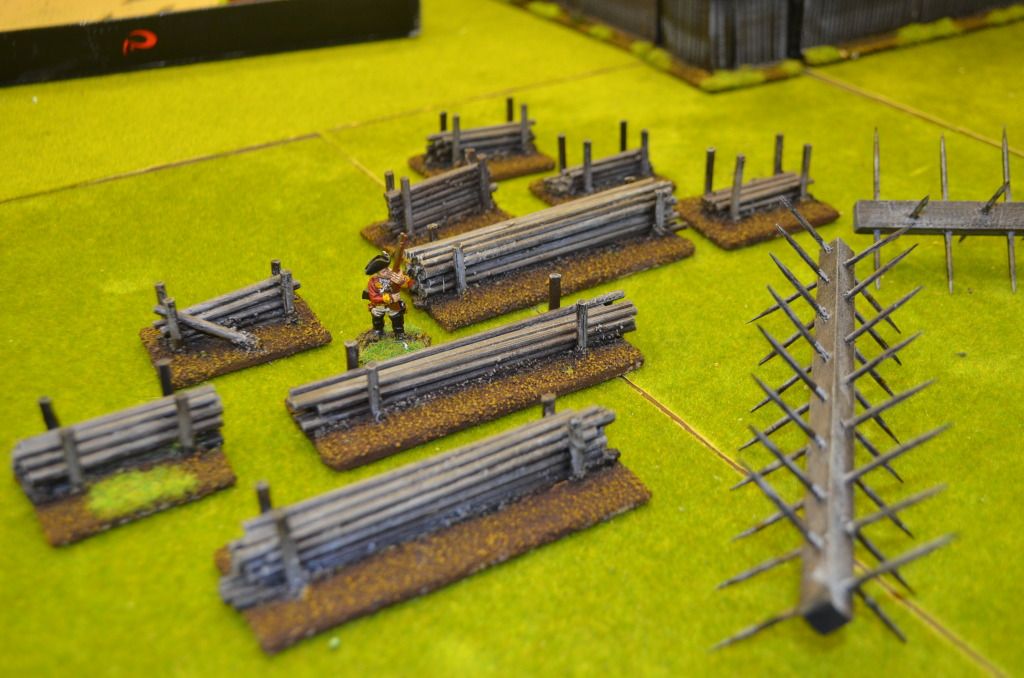
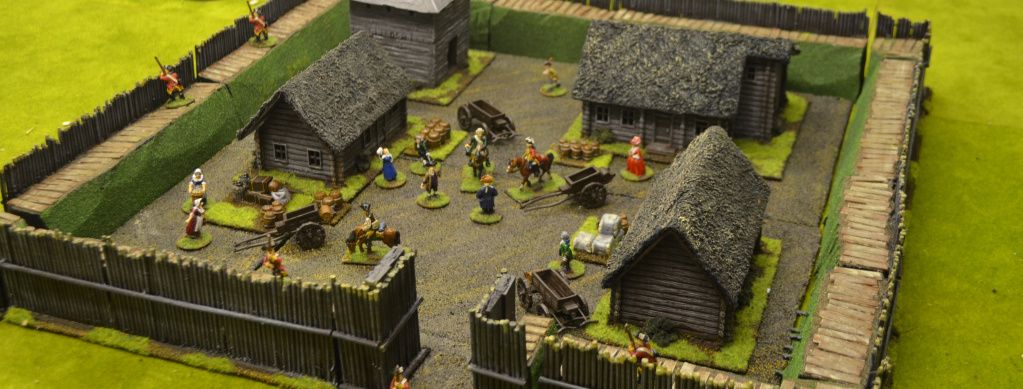
Last Thursday saw another great Muskets & Tomahawks game in the shed. This time round I wrote up a specific scenario which will form the second of three engagements to be fought at the forthcoming BLAM event. It also gave me an opportunity of using all my new terrain.
In essence the players were split into two teams with each team having two distinct roles.
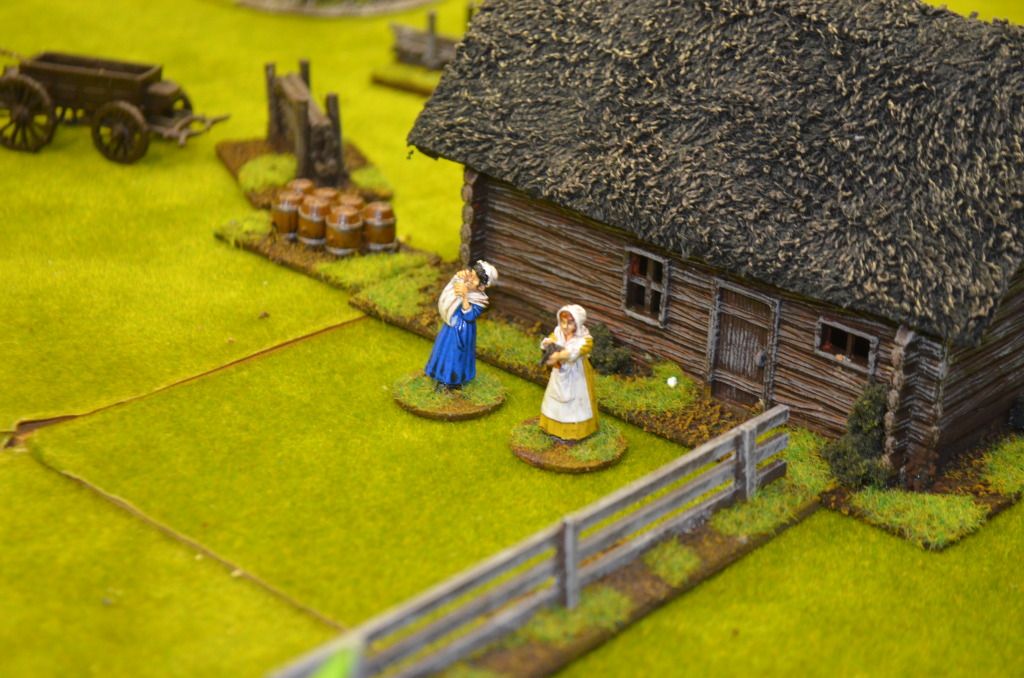
The British players were represented by the forces of Colonel Heathrow in Fort Martin William. The Colonels objectives were relatively straight forward prevent the supplies in the area from falling into enemy hands and ensuring that the local civilians (including his daughters) were protected.
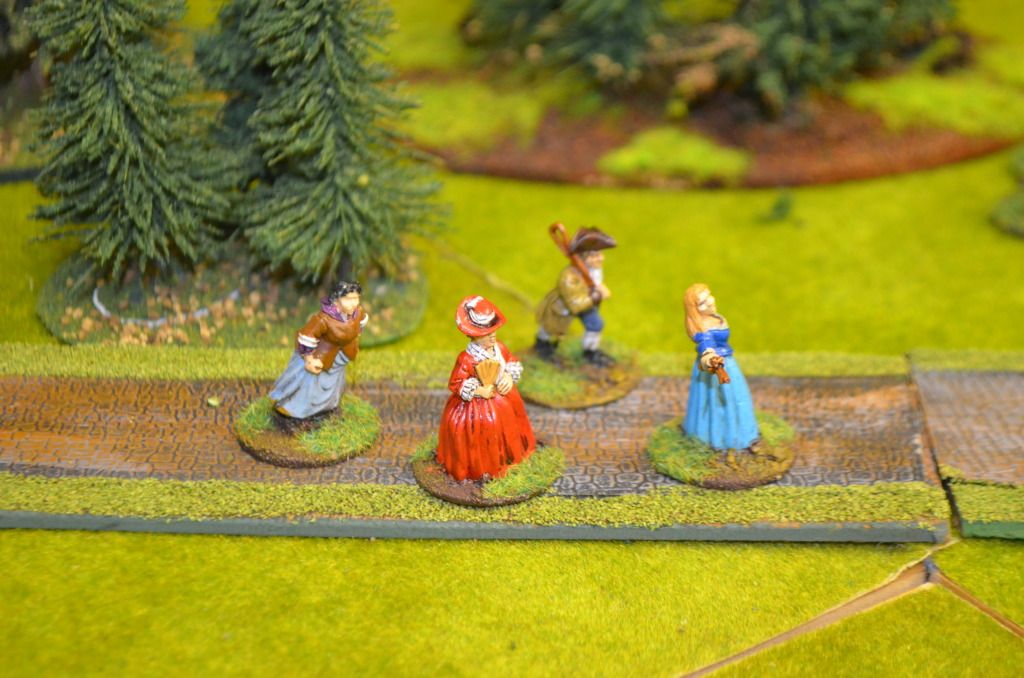
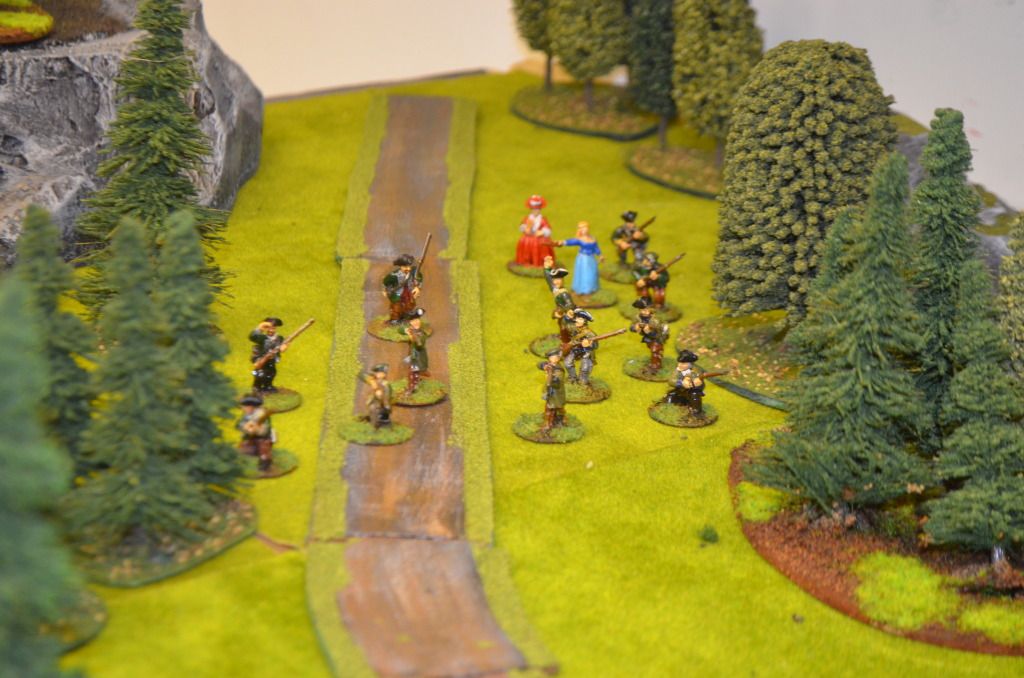
The second British players forces were commanded by Major Stanstead. His irregular units of rangers were under orders to carry important strategic coded documents to Fort Martin William and escort Colonel Heathrow’s daughters to their father.
The French regular force under the command of Colonel Orly were under orders to capture the valuable supplies (or at the very least deny them to the enemy) and search the officers for any important documents and maps relating to British warplans in the area.
Finally the French force were supported by natives under the command of the Sachem know as Black Hawk. Their mission was very straightforward – murder in cold blood (ie not shooting) the Colonels daughters (The Colonel was responsible for the death of Black Hawks sons) and scalp as many of the English Settlers as possible. Black Hawk recognises that terror can only be inflicted on the Civilian population.
Points were awarded for each of the missions completed or deducted for failure.
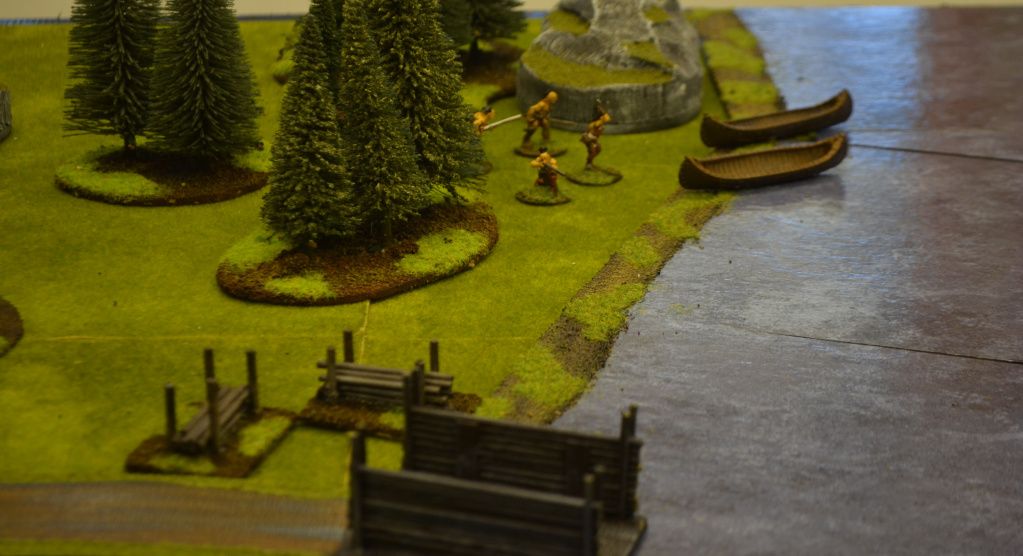
The battlefield, representing a part of the Canadian frontier is divided by a river running East- West. To the South Lies Fort Martin William – it’s a simple palisade affair holding only a few troops. To the outskirts of the fort and alongside the river are the local settlers dwellings. The river is fordable here by a ferry. The supplies are spread across this area.
Running North South is the George Road. This meets the ferry crossing. The Ferry can carry eight men or a cart. A unit may pull itself across minimum of four actions with two men.
The French Forces of Colonel Orly along with his native allies are dispersed across the Eastern edge. A ford lies on the furthest edge of the table. The French regulars are approaching the fort under the cover of night and their native braves hover to their right.
Major Stanstead, along with the Colonels daughters start in the far North Western Edge. They must make their way to the ford and cross at the Ferry if they are to stand any chance of success.
A fifth group was added to the final players list as befitting a game loosely based on the initial part of last of the Mohicans we needed these folks as well.
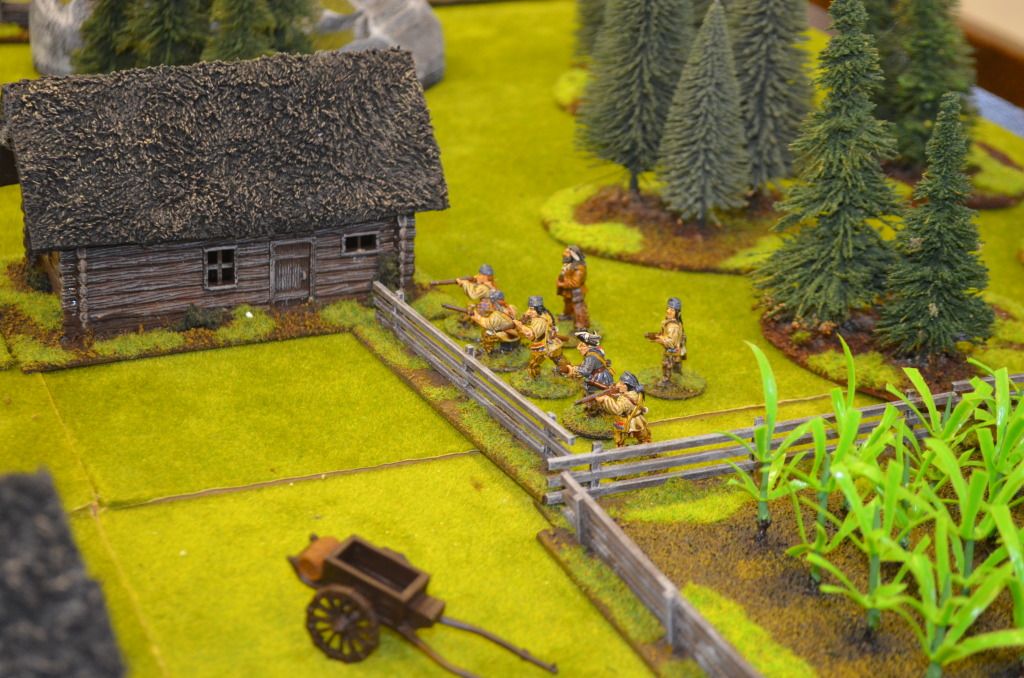
‘Long Rifle, an officer and three ‘Mohicans’ would form the final part of the British Force. To makes these guys more robust in the face of the enemy they were given irregular status, the marksmen trait and Long Rifle himself had a shooting skill of 3+! He would rarely miss as befitting his legendary status.
Long Rifle and his friends would appear in the third round of play with the shared objectives of protecting the Colonels daughters. In addition at least one of the braves had to survive the fight thereby ensuring that there would be a ‘Last of the Mohicans’.
With the forces assembled, the table set up the game commenced. My good mate Matt would take the French and Native Forces whilst Alastair would look after the British ensemble. This was the first time that I had met Alastair having previously opened a dialogue with him on the Studio Tomahawk Forum.
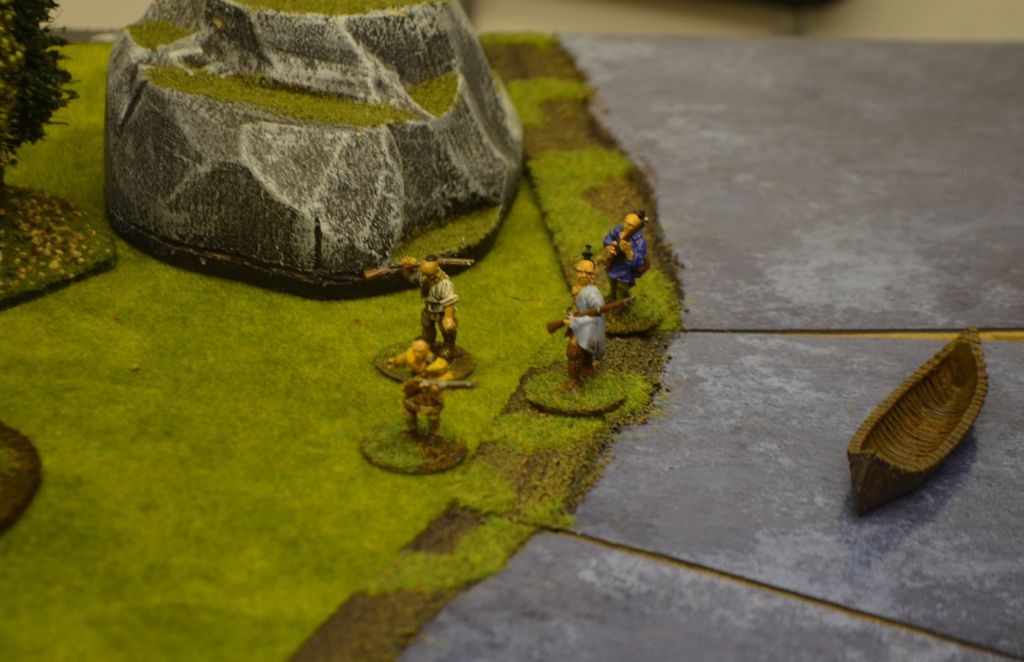
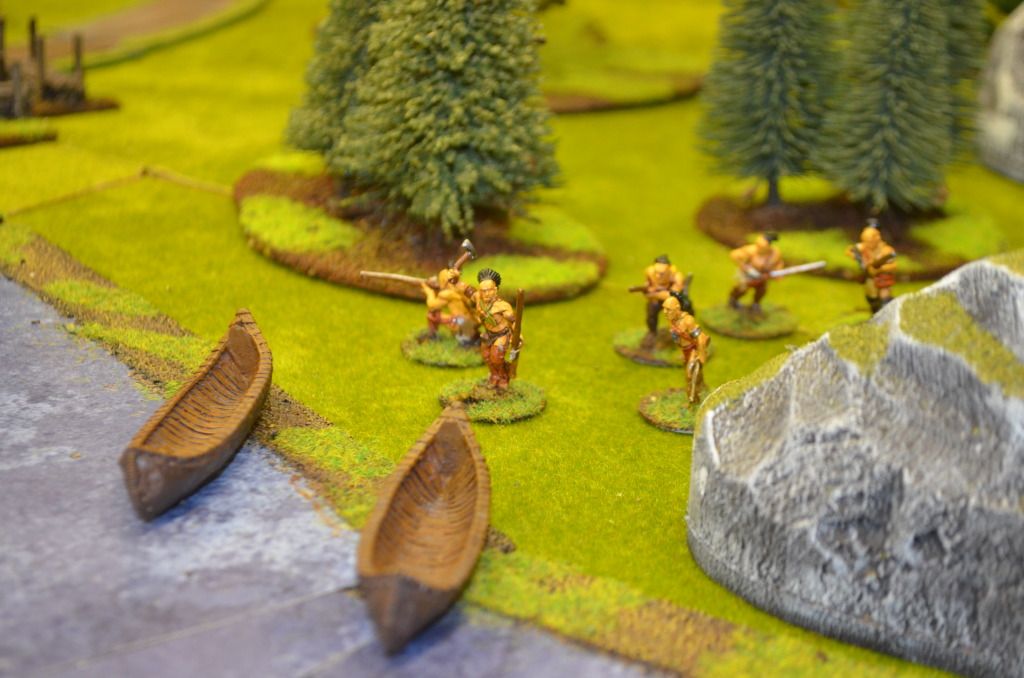
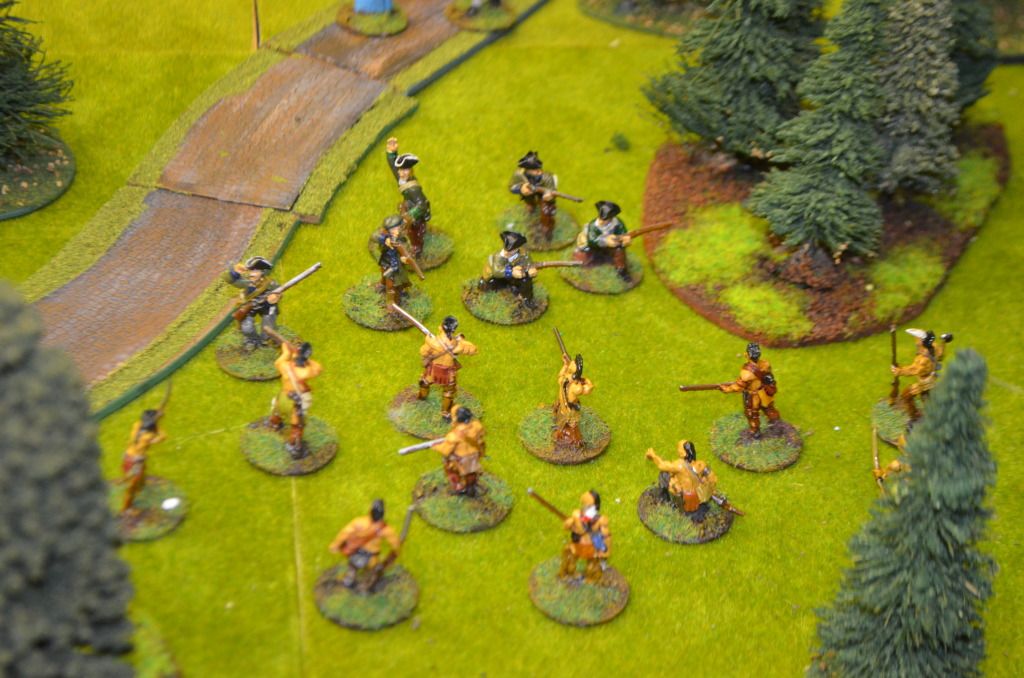
The initial moves saw the Indians (with decoys) spilling out of the village in the south west. Unbeknownst to the British the Indians had canoes on the western edge of the river so crossing the ford via the ferry was not necessary for them. Major Stanstead leading his Rangers and escorting the daughters emerged on the path in the South East and rapidly headed towards the ford.
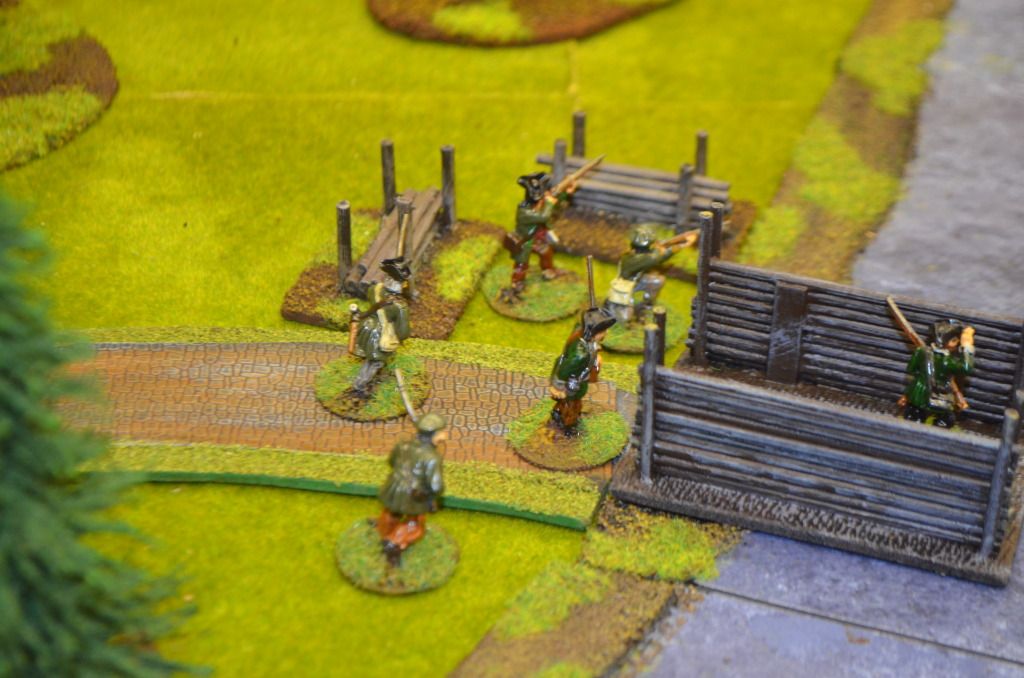
Mean whilst the British aware of approaching French troop readied their defences and directed the local civilians to run for the fort. The local militia were first engaged with the emerging Canadian Irregulars. With initiative passing to these men of the woods their rifles spat at the neatly arrayed locals. Three sixes and three kills decimated the poor guys defending their homes.
French Regulars split in their advance to the fort appeared on both East & Western edges. To counter this threat Colonel Heathrow issued orders for one of his units to advance from the fort and take up positions to counter the threat of the white coats advancing.
At the beginning of turn two the Rangers came under heavy fire from the Indians, backed up by a tomahawk charge. A fierce battle ensued on the river road and quickly one unit of Rangers were wiped out to a man by the fearsome warriors. It wasn’t all one way with one unit of braves being driven off and another severely mauled. With one of the Ranger units now stationed at the ford the poor Colonels daughters and their servants were ever so exposed. Black Heart seized the opportunity to avenge his sons deaths and with a roll of a few dice the Indian chief had his vengeance and scalps to boot.
Skirmishes had erupted all over the board, civilians were running for safety and some dice rolling was amazing – sixes galore.
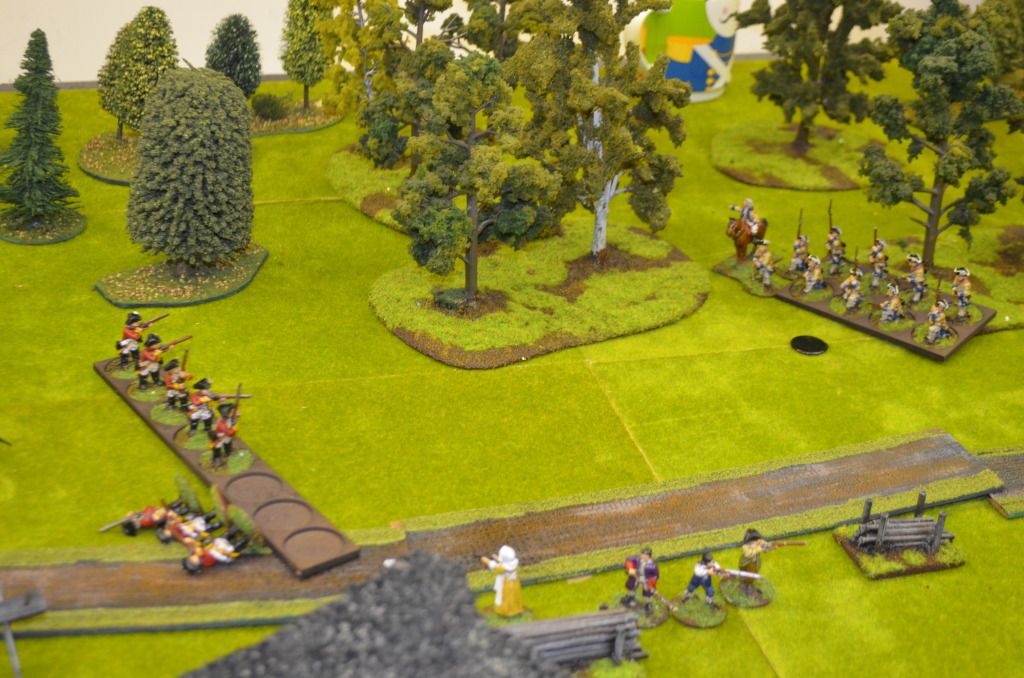
We now come to a pivotal point in the game. The regular British infantry which marched up the road soon came up against a French line unit. From the edge of the woods the French opened fire. Three Red Jackets fell to this blistering volley. The next dice roll beggars belief. Having taken volley fire and losing three stands the regular unit rolled a one for its reaction. With no officer support the unit routed from the table. Half the British Infantry wiped out in one volley! Shocking , what would the papers say...
The French, with their tails up, moved forward and turned their attention to the remaining militia. A couple of cards later the poor defenders lay in a crumpled heap.
Over on the ford the remaining Rangers were engaging with both the remaining Indians and now coming under fire across the water from the Canadians. Things were looking desperate for the British.
Reinforcements arriving in the form of Long Rifle and his braves. Coming in on the river from the East they quickly moved through the woods to attack the French Line in the rear. Some excellent firing soon began to tell.
On the Ford the rangers finally started to haul themselves across the river. However a series of well aimed rile shots from the Canadians drove them back to the starting side. They weren’t going anywhere.
Remember those Indian Canoes ? Well since the beginning of turn one Matt had sent two war parties across the river and into the village looking for scalps. These braves quickly caught up with the civilians from the ford and after a very one sided affair more scalps were added to the points of the rampant savages. These same Indians rapidly crossed the ground towards the fort and by the end of turn three were ready to scale the unguarded eastern ramparts.
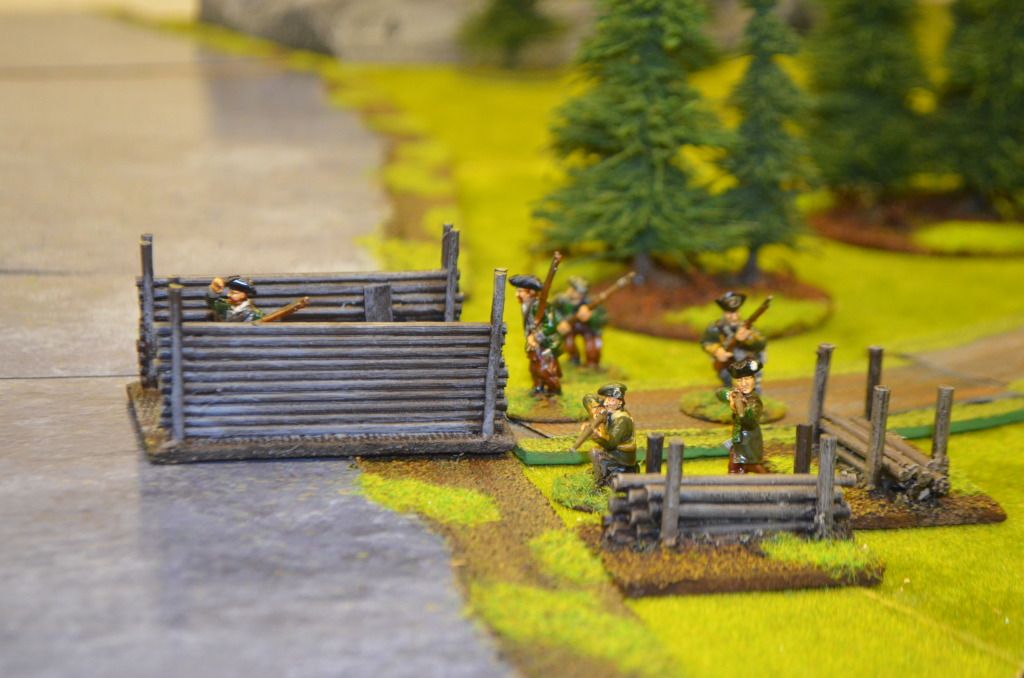
The French Line to the West hastily searched the village securing the supplies therein. A sporadic musketry duel broke out between the redcoats on the palisade wall and these French line, In effectual fire at long range was the order of the day.
With Indians now posed to cross the wall the redcoats defending the fort split in two and as the braves emerged from the shadows of the fort, a vigilant volley crashed out. With two braves down the rest fled in terror. With forces now decimated on both sides we called an end to the game.
In points terms Black Hawk emerged as the overall winner, having successfully murdered the Colonels daughters and bagging a few scalps he quietly disappeared into the forest to give thanks to the sky gods. Colonel Orly had captured most of the supplies and was still in possession of the village. Sadly Colonel Heathrow had not only lost most of his supplies he also had to deal with news that his daughters were no more. The results reflected the battle.
A big thank you to Matt and Alastair for taking part.
What next: Well I have learned a few things that need to be tweaked in this scenario but it is almost set for BLAM in November.
Thanks for reading
Eric